Prescriptions
A proper prescription, in under a minute.
Your medicines with your usual doses, a template for the whole disease, and the exact page beside the form. It prints on your own pad, or goes to the patient’s WhatsApp, signed and checkable by QR.
The prescription on its own from ₹59 a month, on every plan
Ramesh Kumar
AR-0042 · 52 y · M
Allergy: Penicillin
Complaints
Diagnosis
Medicines
- 1Tab Paracetamol 650 mg1-1-1After food · 5 days
- 2Tab Levocetirizine 5 mg0-0-1After food · 5 days
- 3Syp Ambroxol + Guaiphenesin1-1-110 ml · 5 days
- 4Tab Metformin SR 500 mg1-0-1After food · 1 month
Advice · Tests
Remembers you
Your frequent medicines, doses, advice and tests come up first.
Your pad, your look
Logo, header, footer and colours, on A4, A5 or Letter, by drag and drop.
Nine on a page
A long prescription goes compact by itself to fit one page.
On their WhatsApp
The signed PDF with your signature and QR, after any consult.
01Write
Your medicine in four letters, with your usual dose.
The form on the left and the exact page that will print on the right. Fill only what you need: empty sections are not printed.
Medicines
- Tab Augmentin 625 Duo1 tablet · 1-0-1 · After food · 5 days · used 42×
- Medicine list
- Tab Augmentin 375Amoxycillin 250 mg + Clavulanic Acid 125 mg
- Syp Augmentin DDSAmoxycillin 400 mg + Clavulanic Acid 57 mg
Your medicines, with your dose
The first time you prescribe a medicine, it is remembered with its dose, 1-0-1, timing and duration. Type two letters and pick it: the rest fills in, the ones you use most first. A dose changed for one patient stays on their prescription.
3,65,036 Indian brands
Search by brand or by what it contains (amox clav). Each comes with its composition, printed small under the name.
Starred medicines, one tap
Star the medicines you give most in your Library and they wait under the form as buttons: one tap adds the medicine with your usual dose and duration. Until you star any, your most used show there.
Allergy warnings
A medicine that clashes with a recorded allergy is named before you sign, by its name, by what it contains and by drug family: a penicillin allergy warns for Augmentin.
BD becomes 1-0-1
The shorthand you already use: OD, BD, TDS, QDS, HS and ODAC fill in the 1-0-1. SOS, stat, alternate days and weekly are there too, or type your own.
Tapering doses
A tapering or increasing dose prints stage by stage, 20 mg then 10 mg then 5 mg, each with its days, and fills in again the next time.
Repeat the last visit
Repeat last starts today’s visit from the last signed prescription. Or, from the Last visit card beside the form, add its medicines (untick any you are stopping) or everything to what you have written, from any of the last three visits.
Complaints and diagnoses suggested
As you type, yours first, then common ones such as burning micturition or enteric fever.
Age and dose checks
Tramadol, codeine or nimesulide for a child under 12 is named, and so is a dose in tablets on an injection or syrup. A reminder to look again, never a block.
Drafts save themselves
Saved a couple of seconds after you stop typing, kept in the browser if the internet drops, and never overwritten by an older tab.
Keyboard shortcuts
Ctrl + N for a new prescription, Ctrl + K to find a patient, Ctrl + S to save and Ctrl + P to sign and print.
Valid till
Set how many days the pharmacy may dispense it: it prints highlighted under the follow-up.
Radiology in words
X-ray, ultrasound and ECG findings have a box of their own and print under the examination.
A Plan under the diagnosis
Surgery planned, the next steps: a box of its own, printed under the diagnosis.
Extras for your specialty
A glasses prescription with vision and IOP for each eye, pregnancy dates with the EDD and weeks worked out, and body diagrams to mark where to operate. Your specialty turns them on; any doctor can.
02Templates and the Library
Write it once. Add it in one click.
Save a whole visit as a template, and the tests and advice you give together as one button. Less likely to forget, and less time to write.
Add a template to this visit
- Viral fever — adult
- Type 2 diabetes — follow-up
- Acute gastroenteritis — child
- Hypertension review
- Allergic rhinitis
Save this visit as a template…
Diagnosis3 medicines2 tests4 lines of adviceFollow-upin one click
Investigations
Save to LibraryAdvised
CBC Malaria parasite (MP) Widal Urine R/M Dengue NS1 / IgM
+ Fever profile+ LFT+ Lipid profile+ HbA1c+ Chest X-ray PAMore (9) Edit list
Advice
Drink plenty of fluids (2–3 litres a day).
Paracetamol only for fever. No painkillers such as ibuprofen or aspirin.
Come back at once if there is bleeding, vomiting, pain abdomen or drowsiness.
+ Dengue care+ Low salt+ Warning signs+ Steam
Templates for a whole disease
Write a visit for viral fever, type 2 diabetes or gastroenteritis once and save it: complaints, examination, diagnosis, medicines with their doses, tests, advice and the follow-up note. Next time, pick it from Templates and it is all there.
Test bundles
Keep several tests under one button with a name of your own. + Fever profile adds CBC, malaria parasite, Widal, urine and the dengue test at once; a diabetes review or a pre-op workup can be one button too.
A template only adds
Whatever you already typed stays, and nothing is added twice, so fever and cough can be two templates on one visit. Then change anything for this patient before you sign.
Advice bundles
+ Dengue care adds every line you give for dengue: fluids, which painkillers to avoid, when to come back. Single lines such as a low-salt diet sit beside it.
Diagnoses and symptoms in a tap
Your usual diagnoses and complaints are buttons under each box. Fever × 3 days is kept as + Fever, so the duration stays yours to add.
Lists that fill themselves
Every test, line of advice, diagnosis and symptom you sign is counted, so the ones you write most come first. Until your own are there, common ones start you off.
Save to Library as you write
Wrote a good set of advice or tests? Save to Library keeps them, one by one or together under one name, without leaving the prescription.
Your own medicine list
Add medicines before you first prescribe them, with your usual dose, 1-0-1, timing, duration, a tapering dose and what they contain. Remove ones you no longer use, with Undo.
Templates: up to 200 on every plan. The Library comes with every plan. The bundles shown are examples a doctor makes, not lists that come ready.
03Your pad
It prints like your clinic’s own pad.
Keep your printed pads, upload a letterhead you made in Canva, or design one here in your colours. Then choose how the medicines print. You change any of it yourself, with no designer needed.
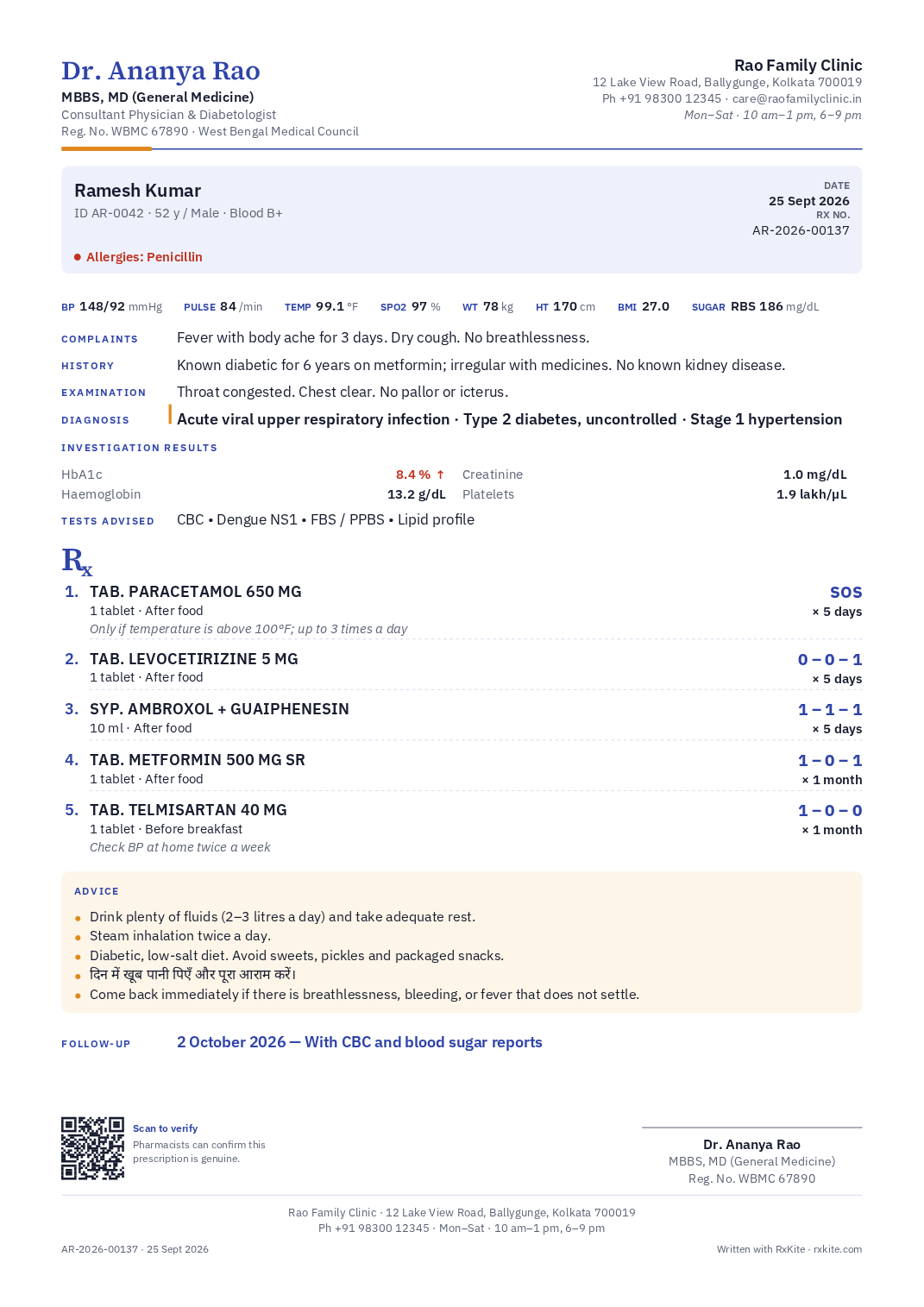
01Your pre-printed pad
Only the prescription prints, inside the blank area, on A5 or A4. A test page with millimetre rulers lines it up.
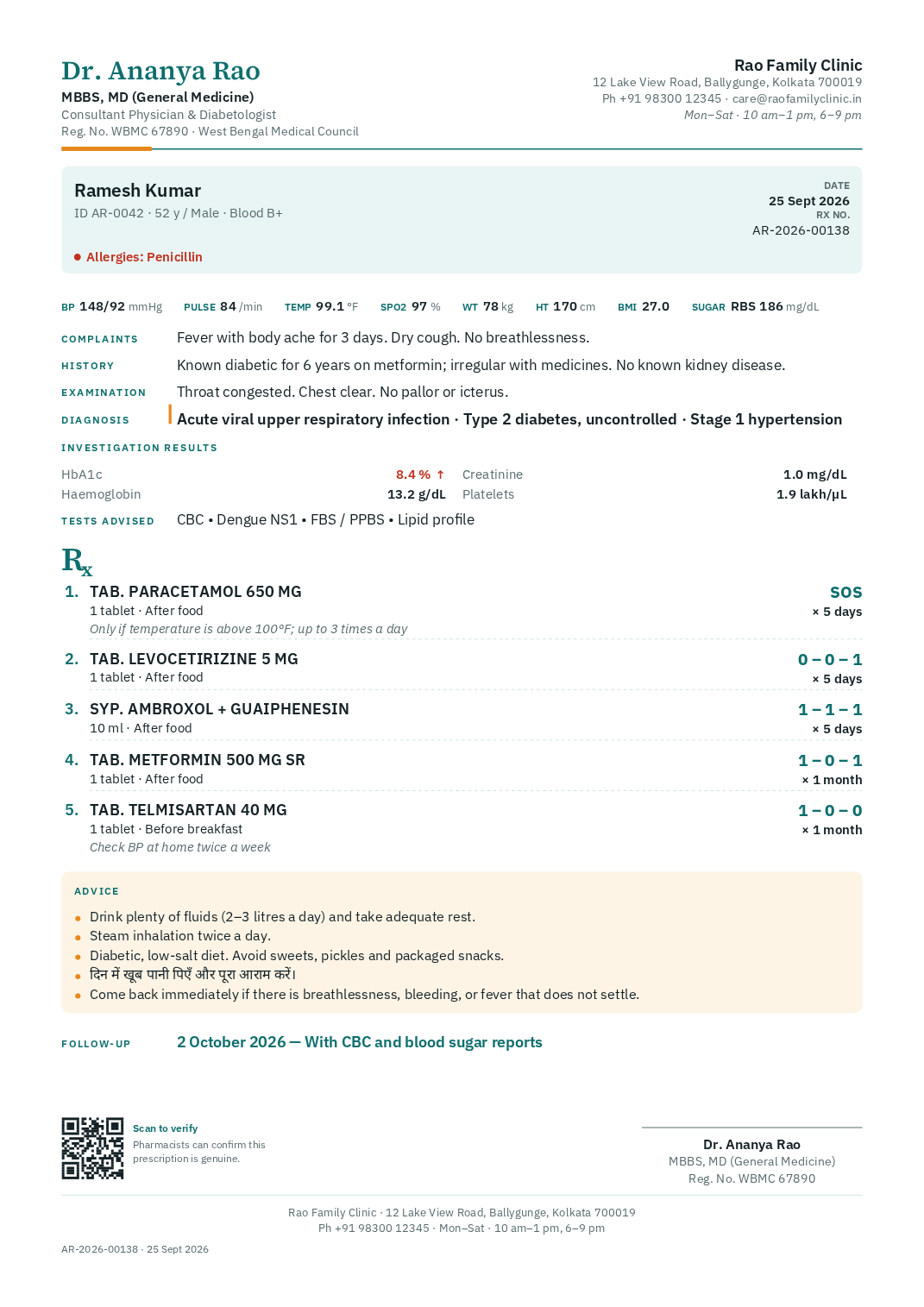
02A pad designed here
Your header, logo, footer and colours, arranged by drag and drop, on A4, A5, Letter or any size.
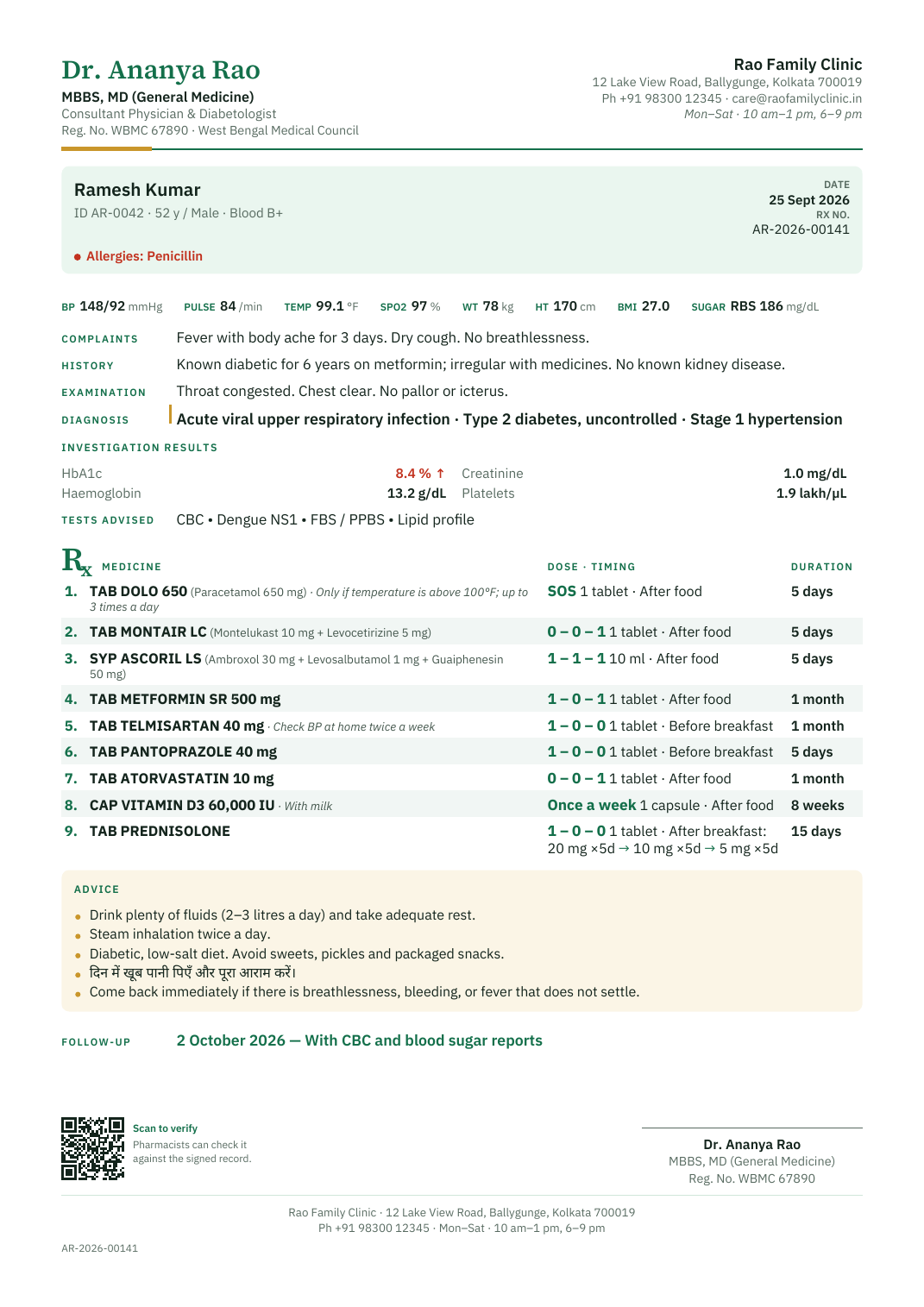
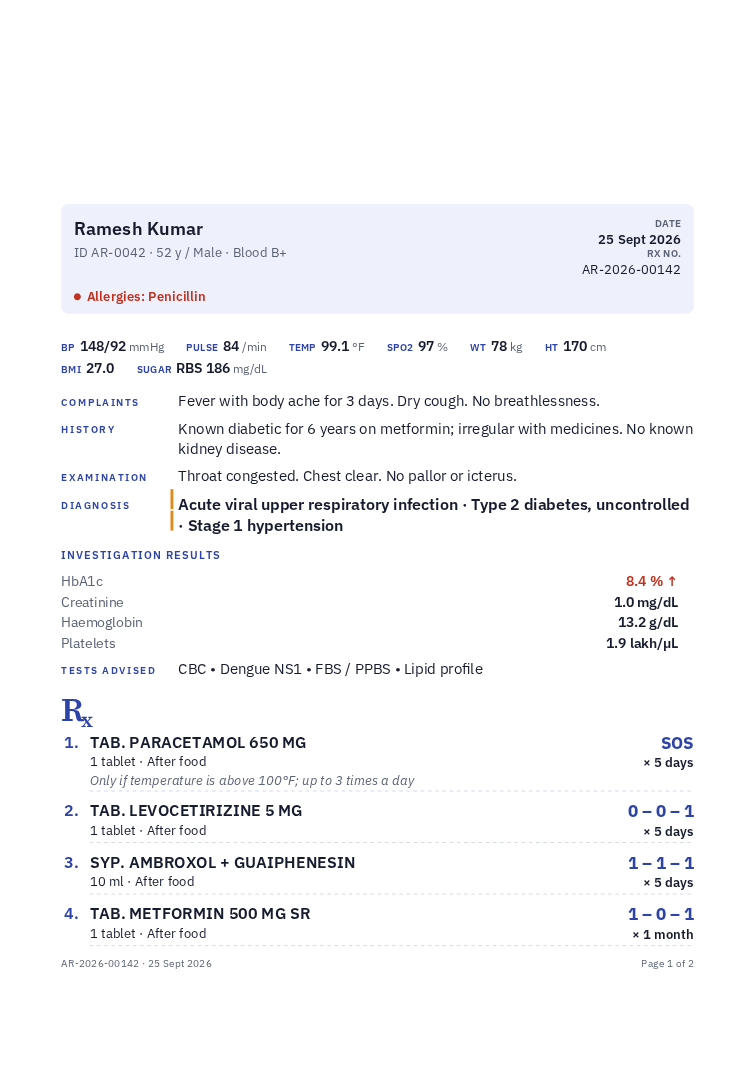
03Compact when it runs long
Nine medicines on one page: a long prescription goes compact by itself, or every time if you choose.
9 ways to print the medicines
Three clear columns, or a table with the quantity worked out. Each pad keeps its own.
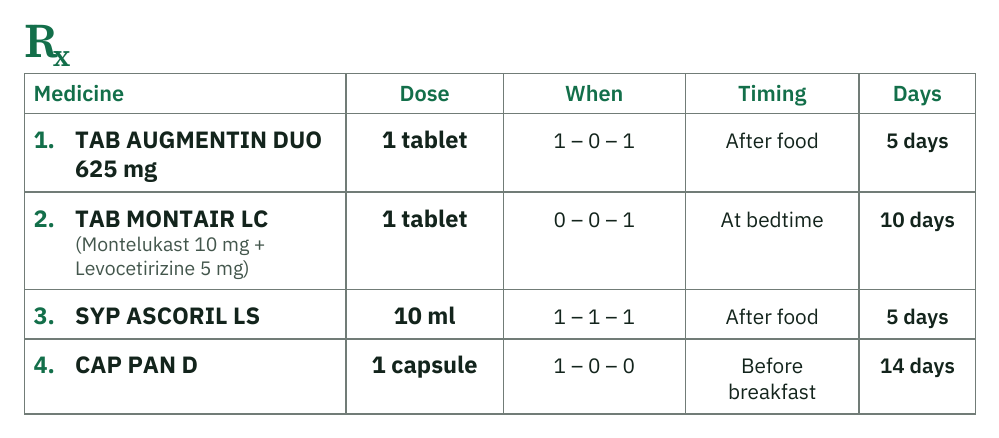
Separate dose and frequency
Medicine, Dose, When, Timing and Days. The amount is bold in its own column, separate from the 1-0-1.
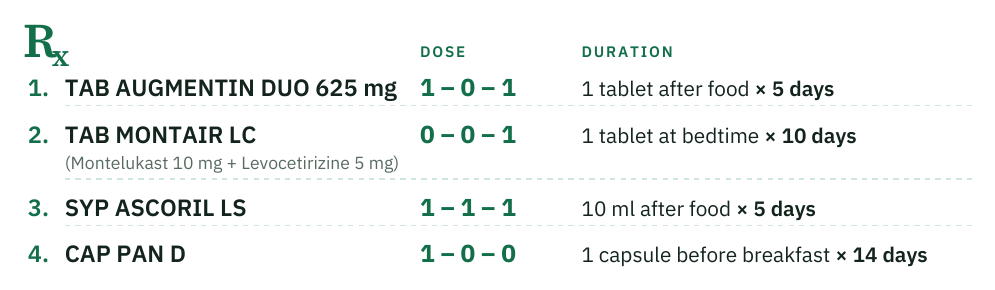
Three columns
The medicine, the 1-0-1, then the dose, timing and days.
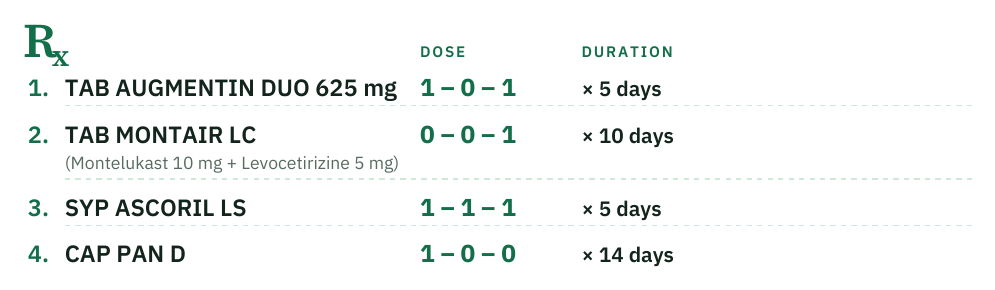
Name, 1-0-1 and days
Three columns, without the dose and meal timing.
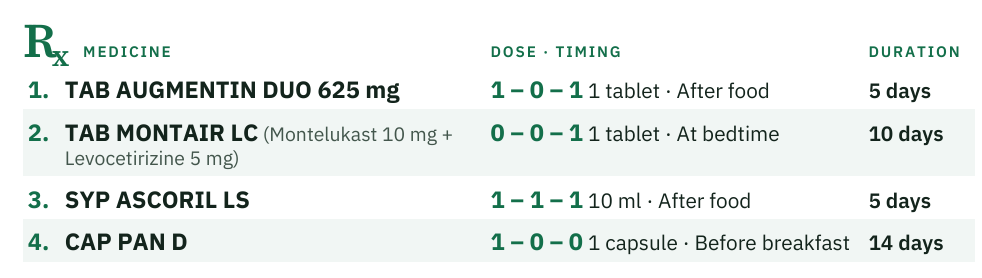
Compact
A line for each medicine on light bands, the dose and timing beside the 1-0-1.
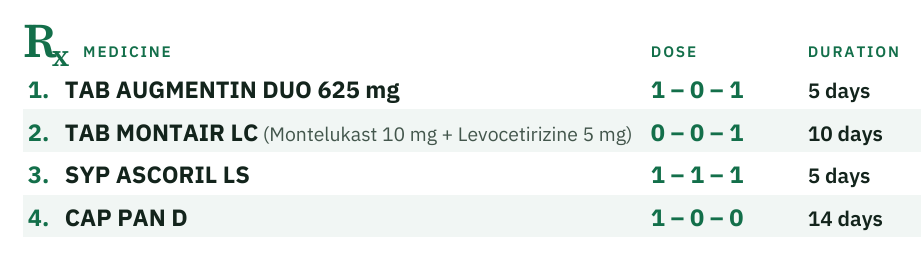
Compact: name, 1-0-1 and days
A line for each medicine, without the dose and meal timing.
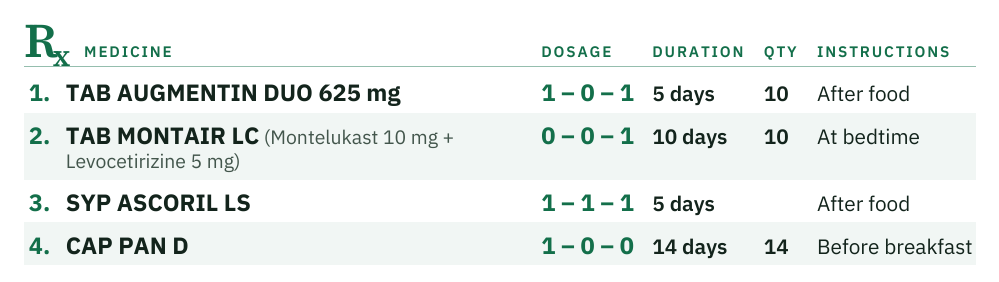
Table with Qty
Medicine, Dosage, Duration, Qty and Instructions, a line each on light bands.
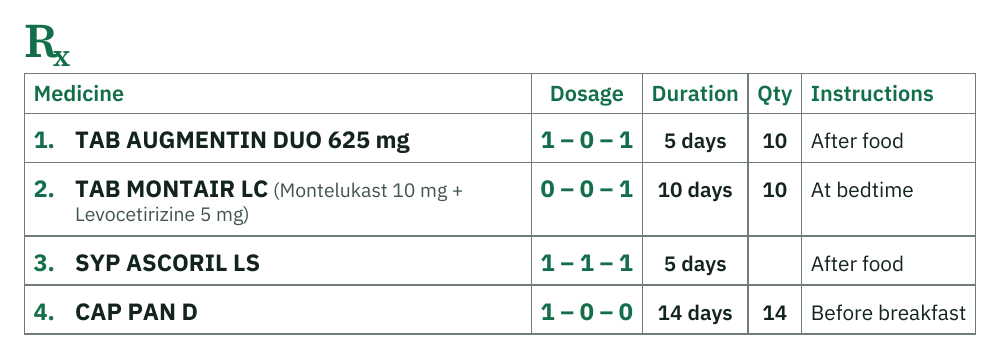
Boxed table
Medicine, Dosage, Duration, Qty and Instructions, each in a box of thin lines, as on a printed form.
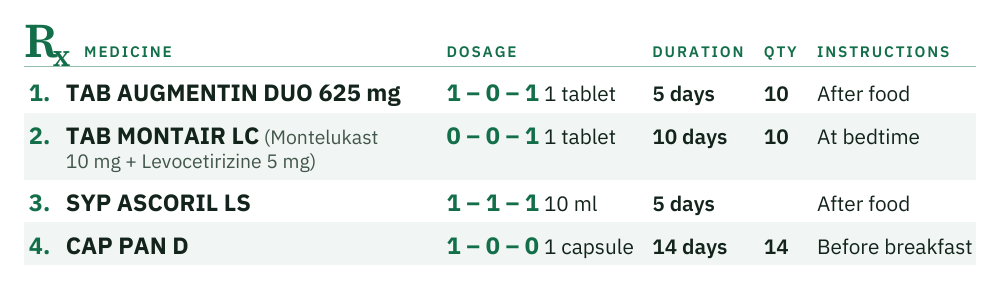
Table with doses
The table, with the dose beside the 1-0-1.
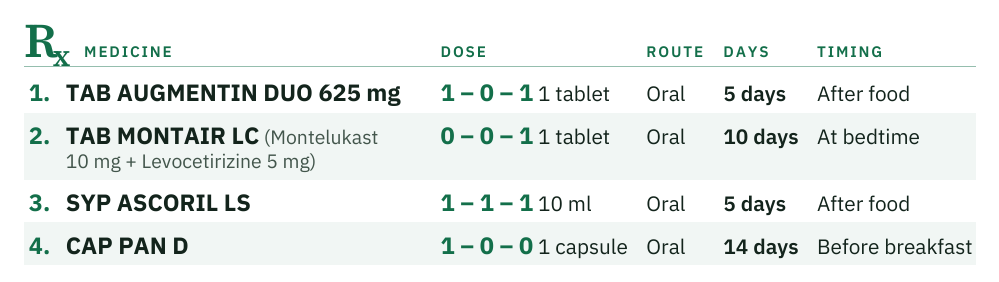
Table with route and timing
Medicine, Dose, Route, Days and Timing, a line each on light bands.
And 7 typefaces (Plex Sans, Arial style, Times style, Source Serif, Garamond, Montserrat, Poppins), your logo or any picture as a faint watermark, and Indian languages, from Hindi and Bengali to Tamil and Malayalam, printed properly beside English, from the patient’s name to the advice.
A letterhead you made in Canva
Upload the whole page as a PDF or picture and the prescription prints in its white middle, on plain paper.
Indian languages
Hindi, Marathi, Bengali, Assamese, Gujarati, Punjabi, Odia, Tamil, Telugu, Kannada and Malayalam, printed properly beside English, from the patient’s name to the advice.
A pad designed here
Your name, degrees, logo, clinic and up to six texts of your own, such as your timings, arranged by drag and drop across the header and footer.
Any paper size
A4, A5, Letter, half letter, or any size in millimetres.
9 ways to print the medicines
Three clear columns, compact a line each, or a table with the quantity worked out, boxed as on a printed form, or with route and timing.
8 colour sets, 7 fonts
Black and white for laser printers among them, your text size, and your logo or any picture as a faint watermark.
Your signature and stamp
Photograph them, crop and straighten, and the paper background is taken out. At each print, choose your printed signature or a space to sign in ink.
Up to 5 pads
One for each chamber, or A5 for the patient and A4 for the file, picked at each print.
You choose what prints
Vitals, history, the prescription number, compositions, the QR, your name and Reg. No. under the signature. The patient’s mobile stays off unless you turn it on.
A note on every page
Such as when to go to hospital, at the foot of every page, bold in a coloured band if you like.
Blank pads for a power cut
Download your pad with empty sections, to write by hand on a home visit or the day the printer fails.
04Send
On their WhatsApp in one tap.
After a visit, a video call, or an ordinary phone call with a patient you know, the signed prescription reaches their phone with your signature and the verification QR.
WhatsApp from RxKite’s number
The signed PDF, in your name. Every plan has credits each month, and the send window shows how many are left.
After a phone call
Advise a patient you know on the phone, then sign and send a proper prescription instead of a photo of a slip.
Email, free
From your name, with your signature, stamp and the verification QR. Replies come to your clinic email.
Video calls
Start one from the patient’s page and send the link. It opens in their browser, with no app to install.
Live chat
Patients send photos and PDFs of their reports. When it ends, save the chat to their record or destroy it.
Private by design
Calls and chats go directly between the two devices, encrypted, and are never recorded. The link stops working when you end it.
A QR the chemist can scan
To check the prescription is genuine and not voided, against the record you signed.
Today
Hello Ramesh Kumar, your prescription from Dr. Ananya Rao for your visit on 25 September 2026 is attached.
Replies to this number are not read, so please contact Rao Family Clinic on +91 98300 12345 for any questions.
Sent by RxKite for your doctor7:42 pm
05Signed and checkable
A medical record, not a loose slip.
Every prescription carries your name and registration, is locked once signed, and can be checked by the chemist with a scan.
Your Reg. No. on every page
Your name, registration number and council, as you entered them, numbered RX-2026-00137.
Signed means locked
A wrong one is voided with a reason and copied into a new draft, never edited after the fact.
A QR the chemist scans
It shows the record as you signed it, with the patient’s initials only, and whether it was voided.
Kept for 10 years
The PDF of every signed prescription is kept in storage that refuses any change for at least 10 years.
06Certificates and letters
Certificates, worded for you.
Fitness, sick leave, medical leave and referral letters, printed on your pad with your signature, stamp and QR, and filed under the patient like a prescription.
- Started from a prescription, the diagnosis comes with it
- Numbered and checkable, never showing the illness
- Not counted against your plan
Numbered, checkable, not counted
Signed and numbered like a prescription, with a QR an employer can scan that never shows the illness. They do not count against your plan.
Fitness certificate
Fit to resume duty, join service, play sport or travel, from a date.
Sick leave certificate
Rest for a short illness, for work, school or college, between two dates.
Medical leave certificate
The formal wording offices ask for, with a tick box for an extension of leave.
Referral letter
To a specialist or hospital, with the reason, how urgent it is, a clinical summary, the diagnosis, treatment so far and the tests.
Nothing typed twice
Start one from a prescription and the diagnosis comes with it; a referral letter also takes the complaints, findings, vitals, medicines and tests.
Do I need training to use it?
No. RxKite opens in your browser on a computer, tablet or phone, with nothing to install. Setting up takes about ten minutes: your details, your pad and one test print, and a short tour shows you around the first time. Type a few letters of a medicine and pick it; from then on it comes up first, with your usual dose. If you get stuck, the guide explains each part step by step, or write to support@rxkite.com.
Can I keep using my printed prescription pad?
Yes. Choose “Pre-printed pad”, enter the height of your printed header and footer, print the test page once to check, and every prescription prints neatly in the blank space. Your name and clinic details are not printed twice.
Can I send a prescription to the patient’s phone?
Yes, after any consult: in the OPD, on a video call, or over an ordinary phone call with a patient you know. Write it as you would in the OPD, sign it, then press WhatsApp to send the PDF to their mobile from RxKite’s WhatsApp number, from your name (one WhatsApp credit; every plan includes some each month), or Email to send it from your name, free. It carries your uploaded signature and the verification QR, and is filed under the patient. For a consult at a distance, start a video call or live chat from the patient’s page and send them the link, by email, WhatsApp or however you like; it opens in their browser with no app. Whether a consultation can be done remotely, and what to prescribe after it, stays your clinical decision under the Telemedicine Practice Guidelines.
What happens when I reach my plan's limit?
The app gives you a heads-up when two-thirds are used, and again at 90%. At the limit, a new prescription cannot be started until you move to a bigger plan, which starts at once with your unused time taken off its price, or, on a monthly plan, the month turns. A prescription you were already writing can still be finished and signed, and every prescription you have already signed still opens, prints and emails as usual.
Write tomorrow’s prescriptions on RxKite.
Setting up takes about ten minutes: your details, your pad, one test print.